How to Stop Dog Jumping on People: A Door Routine That Sticks
September 14, 2026
The doorbell rings, and within seconds, calm turns into chaos. Your dog scrambles across the floor, barks at the threshold, and launches themselves onto whoever walks through the entryway. If you are trying to stop dog jumping on people, the front door is almost always ground zero.
Jumping is rarely an act of defiance. For most dogs, it is a combination of high arousal, instinctive greeting behavior, and a complete lack of spatial boundaries. When excitement peaks, a dog naturally moves into the personal space of humans. The good news is that you do not need gimmicks or physical corrections that rely on kneeing your dog in the chest to fix this. You simply need a clear system, firm management, and consistent threshold manners.
Why Traditional Advice Often Fails
Many common tips for stopping jumping do not hold up in real life. You have likely heard that you should turn your back, cross your arms, or push the dog away. While ignoring a jumping dog works well in sterile obedience demonstrations, it often falls apart when real guests visit your home.
First, physical contact of any kind—even pushing a dog away—is perceived by many social dogs as interactive play. Second, guests rarely follow instructions. When an excited friend walks in, they often lean down, make high-pitched noises, and pet the dog while saying, "It's okay, I love dogs!" This reinforces the exact behavior you are working to eliminate.
To build a reliable pattern, the solution cannot depend on how your guests behave. It must depend on the structure you establish for your dog.
Step 1: Manage the Environment During the Learning Phase
Training takes repetition, and every time your dog successfully jumps on someone, that neural pathway gets stronger. Until your dog understands what is expected of them, you must manage their access to the door.
- Use a designated leash near the entryway: Keeping a slip lead or standard flat leash hanging near your entrance allows you to step on the line or hold your dog before opening the door.
- Utilize physical barriers: A sturdy baby gate placed between the entryway and the living room prevents your dog from rushing the door uninvited.
- Use a crate for unexpected deliveries: If the delivery driver rings the bell and you do not have time to run a structured drill, put your dog in a crate or behind a closed door with a calm chew.
Management is not giving up on training; it prevents your dog from practicing unwanted behaviors while you teach them alternative skills.
Step 2: The Place Command as an Anchor
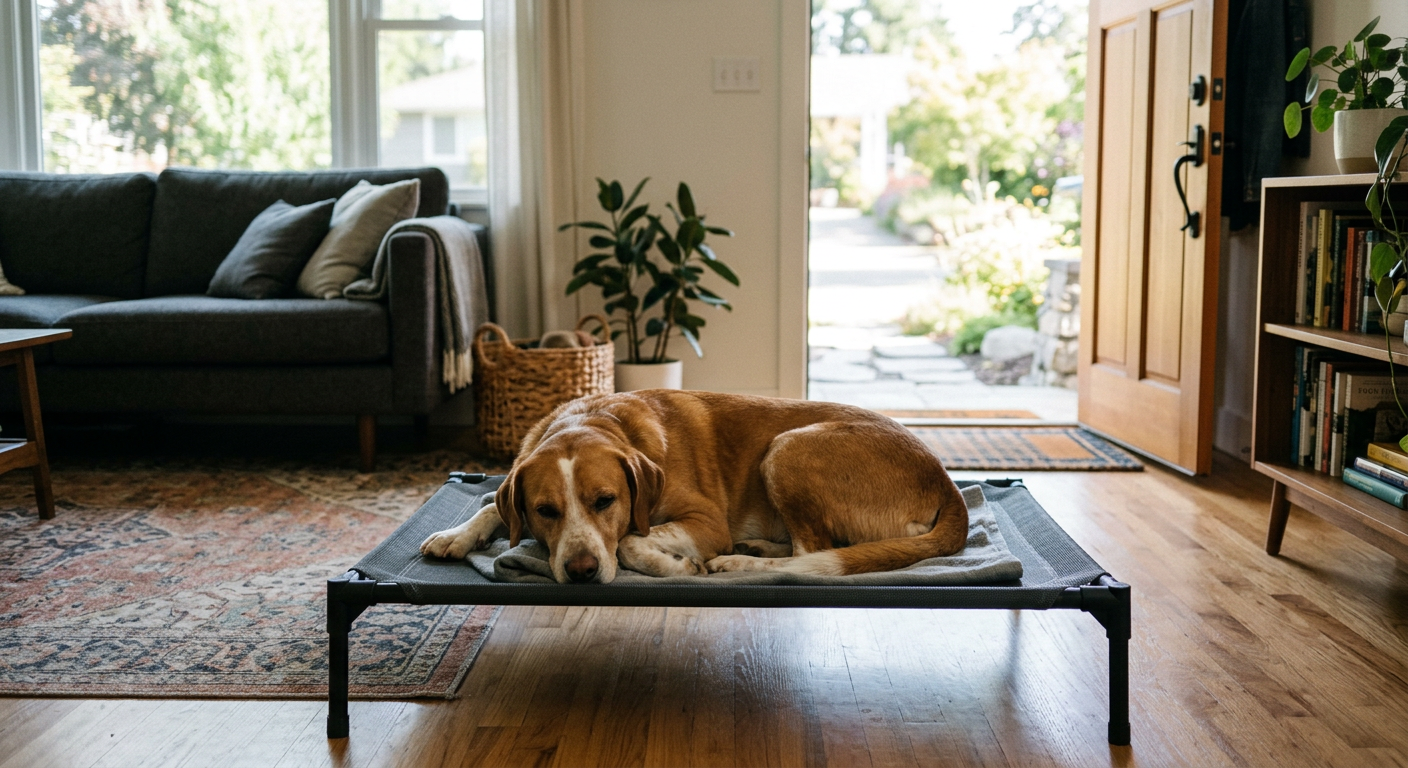
The most effective counter-behavior to jumping is an immovable "Place" command. An elevated dog cot or durable dog bed positioned within sight of the doorway—but ten to fifteen feet away from the threshold—serves as a spatial anchor.
When a dog is on their place bed, their job is simple: stay on the bed until released. This shifts the dog's mental state from "Who is here to interact with me?" to "I have a job to do right here."
Teaching Place with High Value
Begin teaching the place command when nobody is at the door. Lead your dog to the cot, lure or guide them onto it, and mark the moment all four paws are on the surface with a clear verbal marker like "Good" or "Yes." Reward them on the bed.
Gradually build duration by waiting several seconds before rewarding, and slowly increase your distance from the cot. Only release the dog with a clear release cue, such as "Break" or "Free." The bed should become a place of calm neutrality, not anticipation.
Step 3: Step-by-Step System to Stop Dog Jumping on People at the Door
Once your dog can hold a place command for a few minutes in a quiet room, you can begin layering in door-related triggers. Break the process down into progressive stages so your dog never faces more arousal than they can handle.
Stage A: Neutral Door Drills
Practice without any real guests. Send your dog to their place bed and walk toward the front door.
- Touch the doorknob. If your dog stays calm on the cot, walk back and reward them.
- Turn the doorknob and open the door two inches. Close it, return to your dog, and reward.
- Open the door wide to the empty porch. Step outside for two seconds, step back in, and reward your dog on their bed.
If your dog breaks off their bed at any point, do not get angry or yell. Calmly guide them back to the cot, reset the exercise, and decrease the difficulty slightly.
Stage B: Simulated Doorbell and Knocking
Doorbells and knocks trigger sharp spikes in adrenaline. Pair these sounds with calmness before you introduce actual people.
Have a family member tap on the front door or ring the bell from the outside while you stand near your dog's cot. Direct the dog to "Place" the moment the noise happens. Reward heavily on the bed for remaining stationary. Your goal is for the doorbell to become an automatic cue for the dog to run to their cot rather than charging the entryway.
Stage C: Staged Guest Arrivals
Enlist a friend or neighbor to act as a decoy guest. Instruct them beforehand not to talk to, look at, or touch your dog.
- Place your dog on their cot and secure a leash to their collar as a backup.
- Answer the door and invite the helper inside.
- Have the helper stand in the entryway for one minute, having a normal conversation with you, completely ignoring the dog.
- Once your dog shows soft body language and relaxed breathing, you can either release the dog for a calm greeting or simply release them to go back to their day.
Establishing Threshold Manners
A dog should never cross an exterior threshold—front door, back door, or car door—without explicit permission. Teaching threshold manners reinforces impulse control across every area of your dog's life.
Before opening any door, ask your dog to sit. Begin opening the door slowly. If your dog starts to lurch forward, immediately close the door back toward the frame. Do not snap the door on the dog; just close the opening to communicate that movement forward makes the opportunity disappear. When your dog sits patiently with the door wide open, give your release cue and step through together.
Getting Hands-on Help for Consistent Results
Stopping chronic jumping requires calm repetition, clear mechanics, and patience. For busy families throughout Crestview, FL, balancing daily schedules while managing a high-energy dog can feel overwhelming.
Working directly with an experienced professional trainer provides the structure and feedback you need to troubleshoot specific triggers. Through our Private Lessons, we coach you step-by-step in your own home so you can master greeting routines with confidence. For households needing a comprehensive training foundation built by professionals, our Board & Train Programs establish deep-seated impulse control, threshold manners, and reliable place stays in real-world environments.
Calm greetings are not an accident; they are the result of clear expectations and consistent daily habits. Ready to transform your entryway chaos into calm, polite manners? Contact Total Balance K9s today to book your consultation.