Why Dog Obedience Group Classes Offer What Private Training Cannot
October 6, 2026
It is a common story for many dog owners: your dog performs a flawless sit-stay in your living room, walks nicely next to you in the hallway, and recalls instantly when you call them from the kitchen. Yet the moment you step outside into the neighborhood or visit a busy park, that hard-earned responsiveness seems to disappear. When distractions appear, your dog acts as if they have never heard their basic commands before.
This breakdown is completely normal in the learning process. Dogs are contextual learners, meaning a skill learned in a quiet, distraction-free environment does not automatically translate to the chaos of the everyday world. While one-on-one instruction sets the groundwork, dog obedience group classes offer a specific training dynamic that private work simply cannot replicate: systematic, controlled proofing under real-world distraction.
The Foundation: Why Private Work Comes First
Before a dog can succeed in a group environment, they must understand the fundamental mechanics of what is being asked of them. Trying to teach a brand-new behavior in a room full of other dogs is frustrating for both the handler and the dog because the dog's brain is overwhelmed by sensory input.
This is why private lessons are so valuable in the early stages of training. One-on-one sessions give you the space to master leash handling, refine your timing, and clearly teach your dog core commands like sit, down, place, and loose-leash walking without competing for their attention. Private training builds the blueprint. However, once that foundation exists, staying in a low-distraction bubble creates a ceiling on your dog's reliability.
The Power of Controlled Distraction in Dog Obedience Group Classes
To build a dependable dog, you must move through a process trainers call proofing. Proofing involves gradually increasing the difficulty of an exercise by changing three variables: distance, duration, and distraction. Of these three, distraction is often the hardest for pet owners to manufacture safely on their own.
When you walk down a public sidewalk, you cannot control the environment. You might encounter an off-leash dog rushing toward you, a child darting past on a scooter, or an owner who allows their dog to bark directly in your dog's face. These unpredictable encounters can set training back if your dog is not yet ready to handle that level of intensity.
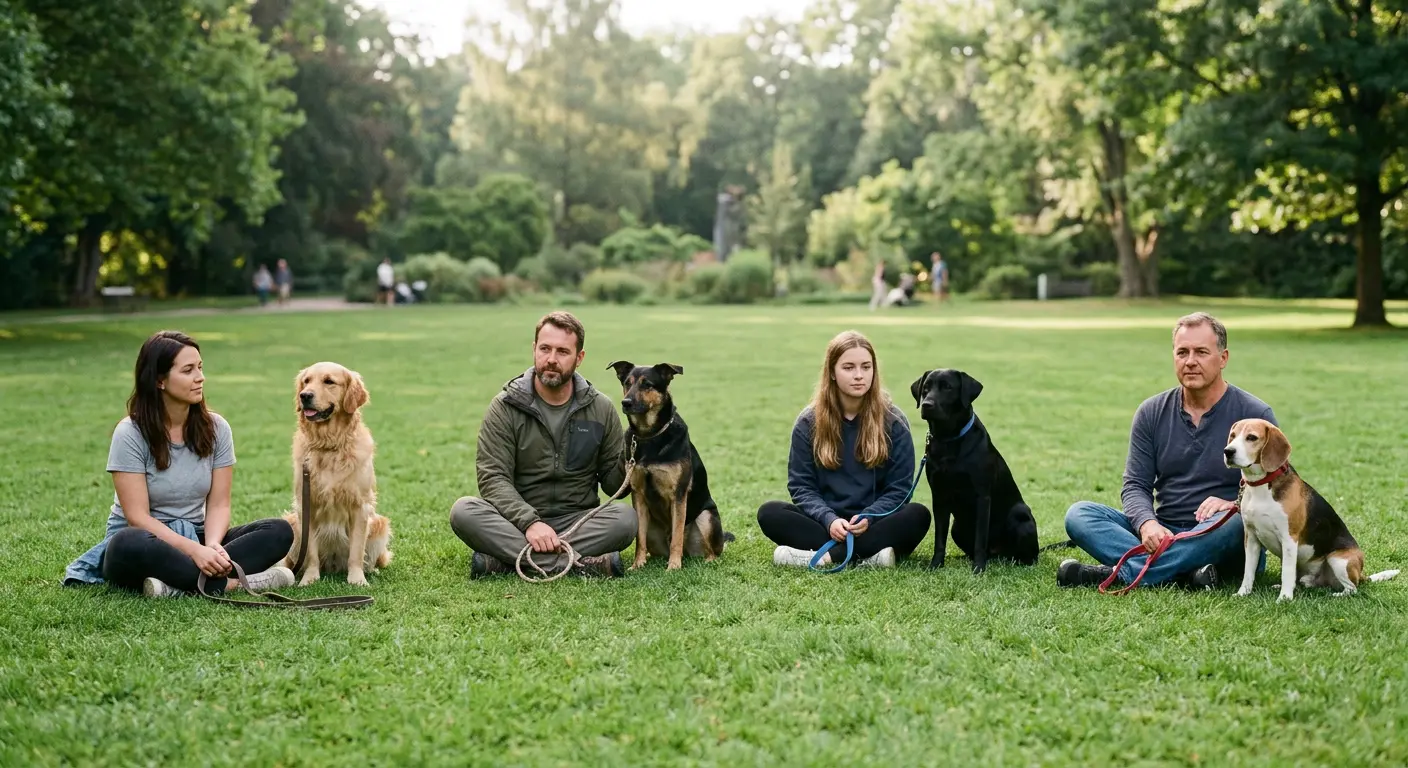
Dog obedience group classes solve this problem by creating a structured environment where distractions are intentional, controlled, and scalable. In a group setting, every person and dog present is working toward the same goal. The trainer manages spacing, controls movement, and sets up scenarios designed to challenge your dog just enough to encourage focus without pushing them over their threshold.
Moving Beyond the Living Room Bubble
When dogs learn a behavior in one specific setting, they often associate the cue with that exact picture. A dog might believe that "down" means lie down on the living room rug while my owner stands directly in front of me holding a treat bag.
Changing the picture is essential. In a group class, your dog learns that commands apply regardless of:
- The presence of other dogs working several feet away
- Different handlers giving verbal cues simultaneously
- Sudden environmental movements, such as dropped leashes, handler changes, or walking past unfamiliar objects
- Different flooring, lighting, outdoor scents, and ambient neighborhood noise
By repeatedly practicing known commands in this dynamic environment, your dog generalizes their obedience. They learn that their handler's voice remains relevant no matter what is happening in the surrounding space.
Neutrality Over Socialization
There is a widespread misconception that group classes are meant for dogs to play with one another. In reality, effective group training focuses on the exact opposite: neutrality.
A dog that expects to greet every dog they see will often develop frustration, reactivity, or over-arousal on the leash. True socialization is not about physical interaction; it is about teaching your dog to remain calm, indifferent, and focused in the presence of novel stimuli.
In our structured group classes and pack walks, dogs learn that other dogs in the environment are not playmates to rush toward or threats to worry about—they are simply background scenery. This mindset shift is transformative for owners who want to enjoy peaceful walks through local farmers markets, outdoor dining patios, or busy parks.
Proofing Commands Under Real Pressure
Practicing in a group setting allows you to systematically test your dog's impulse control under conditions that mirror daily life across Northwest Florida. Whether you are navigating neighborhood sidewalks in Crestview, FL or walking along busy coastal pathways, your dog will encounter situations where they must choose focus over temptation.
During group instruction, handlers work through practical exercises such as:
- Heeling past other working teams: Teaching your dog to maintain loose-leash positioning while walking closely past another dog without pulling, staring, or lunging.
- Extended duration stays: Asking for a sit-stay or down-stay while other dogs and handlers move around the room.
- Recall past distractions: Calling your dog to come straight to you while other dogs remain seated along the path of travel.
- Threshold manners: Practicing calm entries and exits through doorways and gates when other dogs are nearby.
These exercises expose small weaknesses in handling and timing that you might never notice at home. When a mistake happens in a class, your trainer can immediately help you correct your mechanics, adjust your body language, and reset the picture constructively.
Building Handler Confidence and Resilience
Group classes are just as valuable for the person holding the leash as they are for the dog. Handling a dog when adrenaline is high requires practice. When your dog reacts or loses focus in public, it is easy to become tense, pull back on the leash, or rush through commands, which only signals more anxiety to your dog.
In a group setting, you learn to manage your own composure. You discover how to read your dog's subtle body language cues before they react, how to use spatial pressure effectively, and how to calmly advocate for your dog's personal space.
Watching other handlers work through similar hurdles also provides perspective. Dog training is not a straight line of constant progress; it involves plateauing, troubleshooting, and continuous repetition. Seeing other teams work through challenges reinforces that patience and consistency are what create a dependable family dog.
Finding the Right Balance for Your Dog
Private lessons and group classes are not competing methods; they are complementary stages of a complete training journey. Private coaching gives you the skills, clarity, and foundation. Group classes provide the arena where those skills are tested, strengthened, and refined into habits you can rely on anywhere.
If your dog understands their basic obedience but struggles to maintain focus when life gets busy, stepping into a structured group environment is the logical next step toward lasting reliability.
Ready to take your dog's training to the next level? Contact Total Balance K9s to schedule a consultation and find the right training path for you and your dog.
Explore private lessons and dog training in Crestview.