Building a Bulletproof Recall: Practical Dog Recall Training for the Real World
September 4, 2026
Most dogs have a great recall inside the house. You open the refrigerator, open a treat bag, or call them from the hallway, and they come running immediately. However, the real test of a reliable come command happens outside, where the environment is full of competing motivators like squirrels, other dogs, blowing leaves, and open space. True dog recall training is not about teaching a dog what the word "come" means in a quiet living room; it is about building the discipline, relationship, and proofed mechanics required for your dog to turn away from high-value distractions and return to you every single time.
Building a recall that holds up in open spaces requires patience, deliberate progression, and consistency. When you strip away the shortcuts and focus on fundamentals, you create a command that keeps your dog safe and gives both of you far more freedom.
The Foundation of Effective Dog Recall Training
A recall is a high-stakes behavior. Unlike a sit or a down, where a failure to respond simply results in resetting the dog, a failed recall outside can put your dog in immediate danger. To build reliability, you must understand how dogs prioritize their decisions.
When you call your dog, you are asking them to leave something interesting and return to you. In a distraction-free room, choosing you is easy because you are the most engaging element present. Outdoors, the environment provides massive competing value. If your dog learns that ignoring you carries zero consequence and allows them to keep exploring, the cue loses its power.
Reliable recall rests on three pillars:
- Clear value: Returning to you must consistently be a rewarding, positive event.
- Accountability: You must have a physical way to prevent the dog from ignoring you during the learning phases.
- Progressive difficulty: You cannot skip from the kitchen straight to an open field and expect success.
Never Poison Your Recall Cue
One of the most common reasons a dog stops coming when called is cue poisoning. Cue poisoning happens when a dog begins to associate the recall word with an unpleasant outcome or when the word is repeated so often without enforcement that it becomes background noise.
Calling the Dog for Unpleasant Tasks
If the only time you call your dog in the backyard is to clip their nails, give them medicine, put them in a crate, or end their fun at the park, they quickly learn the pattern. They realize that responding to "come" means the fun stops.
Instead, walk over to your dog calmly to leash them or take them inside. Save your formal recall cue for moments where you can reward them heavily, release them back to play, or create an engaging interaction.
Repeating the Cue Without Leverage
If you call your dog three, four, or five times while they ignore you, you are actively teaching them that the cue is optional. Every time you say "come" and your dog continues sniffing a fence line, the value of that word diminishes.
Never use your formal recall cue if you are not in a position to back it up or help your dog succeed. If your dog is off-leash in a novel environment and has not been fully proofed, do not scream the recall cue across a field. Go get them quietly, reset, and adjust your training setup.
Mastering the Long Line
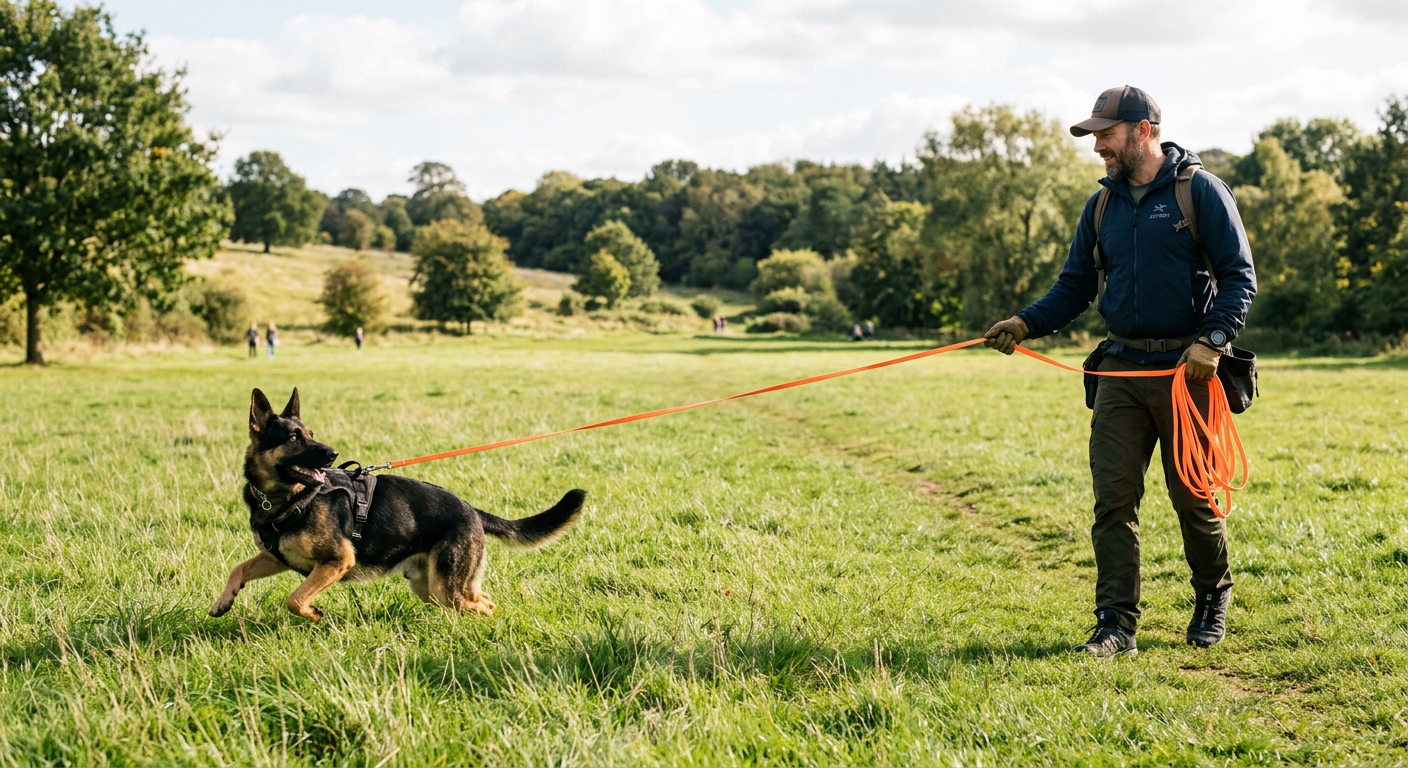
The long line is the bridge between a short leash and off-leash freedom. It is the single most valuable tool for proofing a reliable recall in outdoor environments.
A standard biothane or lightweight webbing long line—typically 15 to 30 feet in length—allows your dog to experience freedom and explore while keeping you in complete control.
How to Work the Long Line
- Let the dog wander: Allow your dog to move away from you to the end of the line and engage with the environment naturally.
- Call once: Use your recall cue in a clear, upbeat, and decisive tone.
- Guide, do not yank: If the dog turns immediately, praise enthusiastically and back up to encourage momentum. If the dog hesitates or ignores you, apply gentle, steady line pressure to guide their movement toward you.
- Reward at the finish: When the dog reaches you, deliver a high-value reward—whether that is top-tier food, a favorite tug toy, or genuine verbal and physical praise.
- Release back to exploration: Often, the best reward for coming when called is being released right back to what they were doing. Tell your dog "free" or "go play" and let them return to sniffing. This breaks the association that recall always ends the fun.
For dog owners working through hands-on handling issues or looking for personalized coaching, our private lessons provide direct instruction on proper leash mechanics, line handling, and body language.
Proofing Recall Around Real-World Distractions
A dog that comes when called in a quiet backyard may completely fall apart when they spot another dog on a walk. This breakdown happens because the recall was never systematically proofed against escalating distractions.
Proofing means teaching the dog that the rules remain unchanged regardless of the environment. Follow a step-by-step hierarchy when increasing difficulty:
- Distance: Build distance before adding heavy distractions. Start at five feet, then fifteen, then thirty.
- Low-level distractions: Practice in a familiar yard with minor outdoor stimuli, such as wind, birds, or distant traffic.
- Medium distractions: Move to a public park during quiet hours, working on a long line around interesting smells and movement.
- High-level distractions: Practice around other dogs, people, or active environments while maintaining leash safety.
Structured environments are an exceptional way to practice these skills safely. Participating in structured group classes and pack walks gives handlers the controlled space needed to proof commands around neutral dogs and handlers before testing them in unpredictable settings.
Consistency Across Northwest Florida Environments
Living in the Florida Panhandle presents unique environments for outdoor recall work, from local community parks to wooded nature trails. If you are training around Crestview, FL, you will encounter everything from high heat and humidity to dense wildlife scents and busy public spaces.
Always adjust your expectations to the environment. If your dog has only ever practiced recall on a flat grass lawn, taking them to a trail full of new wildlife smells will feel like starting from scratch. Be prepared to step back to the long line, shorten your distance, and increase your reward value whenever you enter a new, highly stimulating location.
Building Habits That Last
A dependable recall is built through thousands of positive repetitions, clear boundaries, and fair guidance. It is not an overnight fix, but rather an ongoing habit cultivated through daily interactions. When you protect your cue, use the right tools to enforce consistency, and reward your dog generously for making the right choice, you build a recall that holds up when you need it most.
If you want help building reliable obedience and a stronger working relationship with your dog, we are here to help. Contact our team today to schedule a consultation and take the next step in your dog's training.